Configure Data Transmission
LoRa
- Report Settings
-
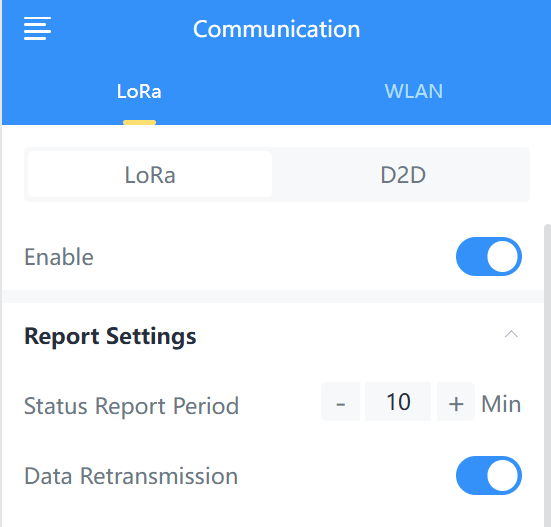
Parameters Description Status Report Period The interval of reporting regional usage and alarm data to network server. Default: 10 min, Range: 1 ~ 1440 min Data Retransmission When enabled, if the LoRa connection is lost, the device stores data locally and automatically uploads it once the connection is restored. Note: It is necessary to enable the Rejoin Mode for this feature.
- Trigger Report
-
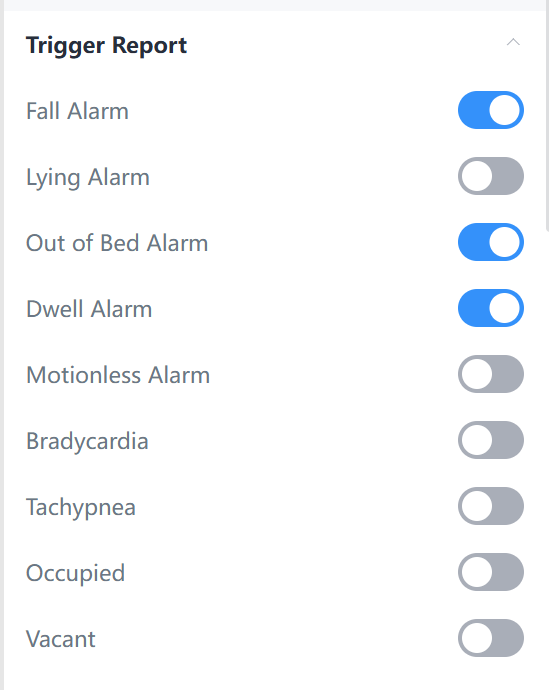
Parameters Description Alarm Type Enable or disable the reporting of corresponding alarms when they are triggered. For trigger data details, see Uplink Packets.
- LoRaWAN Settings
- Configure AppEUI, Join Type, Application Key, and other information. You can
also keep all settings by default.
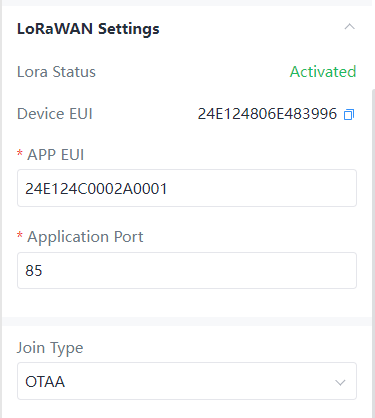
Parameters Description LoRa Status LoRaWAN® network joining status of this device. Device EUI Unique ID of the device which can be found on the device. Note: please contact sales for device EUI list if you have many units.App EUI The default App EUI (join EUI) is 24E124C0002A0001. Application Port The port used for sending and receiving data, the default port is 85. Device Type It’s fixed as Class C. Join Type OTAA and ABP mode are available. Note: it's necessary to select OTAA mode if connecting device to Milesight Development Platform.Application Key Appkey for OTAA mode, default value: "Device EUI" + "Device EUI" (since Q4 of 2025). Example: 24e124123456789024e1241234567890 Note:- The default value of earlier devices is 5572404C696E6B4C6F52613230313823.
- Please contact sales before purchase if you require random App Keys.
Network Session Key Nwkskey for ABP mode, the default is 5572404C696E6B4C6F52613230313823. LoRaWAN® Version V1.0.2 and V1.0.3 are available. Supported Frequency Enable or disable the frequency to send uplinks. If frequency is one of CN470/AU915/US915, enter the index of the channel to enable in the input box, making them separated by commas. Examples:
1, 40: Enabling Channel 1 and Channel 40
1-40: Enabling Channel 1 to Channel 40
1-40, 60: Enabling Channel 1 to Channel 40 and Channel 60
All: Enabling all channels
Null: Indicate that all channels are disabled
RX2 Data Rate RX2 data rate to receive downlinks. RX2 Frequency RX2 frequency to receive downlinks. Unit: MHz Spreading Factor If ADR mode is disabled, the device will send uplink data following this SF parameter. The higher the spreading factor, the longer the transmission distance, the slower the transmission speed and the more the consumption. Tx Power Tx power (transmit power) refers to the strength of the outgoing signal transmitted by the device. This is defined by LoRa alliance. Confirmed Mode If the device does not receive ACK packet from network server, it will resend data once.
ADR Mode Enable or disable network server to adjust Spreading Factor, Bandwidth an Tx Power to optimize data rates, airtime and energy consumption in the network.
Milesight D2D
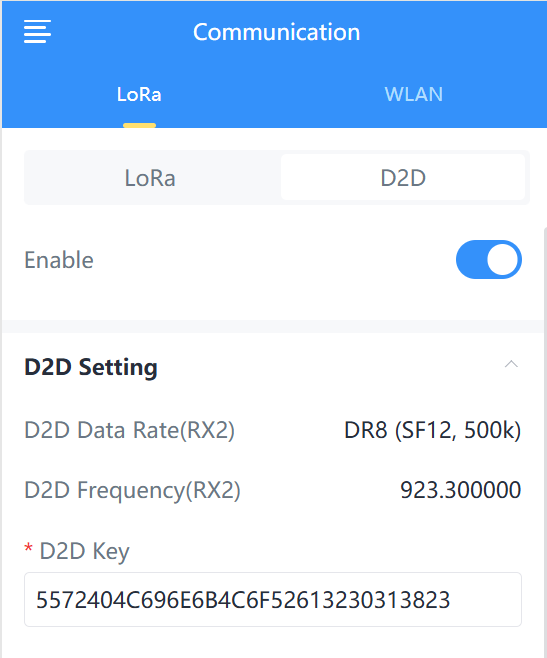
- Milesight D2D Controller
Step 1: Go to General Settings page to enable and configure alarm parameters.
Step 2: Configure the RX2 datarate and RX2 frequency.Note: It is suggested to change the default values if there are many LoRaWAN® devices around.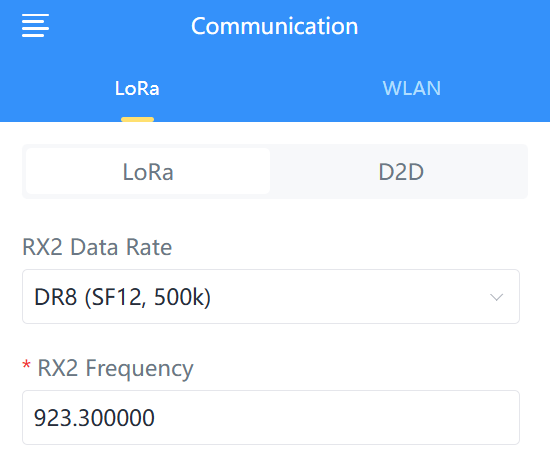
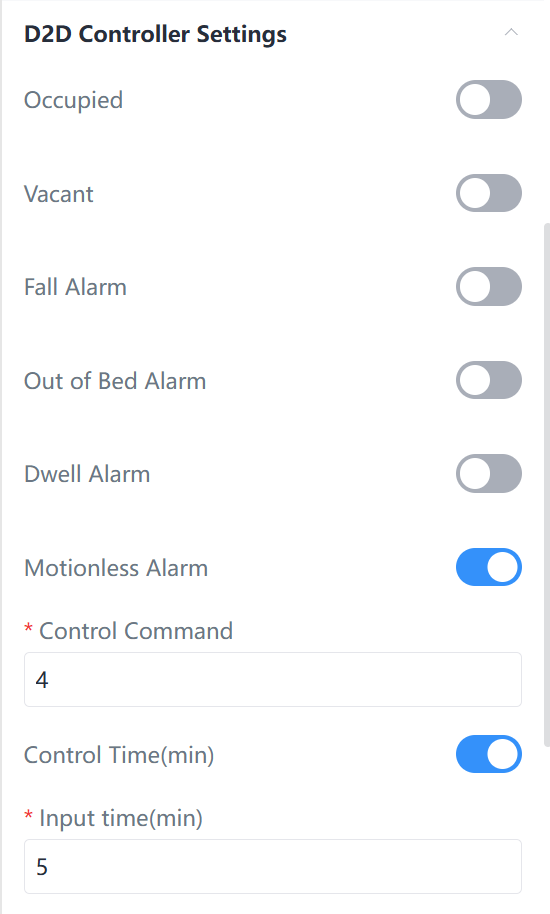
Step 3: Enable Milesight D2D feature and define a unique D2D key that is the same as Milesight D2D agent devices. (Default D2D key: 5572404C696E6B4C6F52613230313823)Step 4: Enable one of statuses and configure 2-byte hexadecimal Milesight D2D command.Note: After enabling the Control Time, Milesight D2D agent devices will take corresponding actions within this duration after receiving commands from Milesight D2D controller. This feature is currently under development for Milesight D2D agent devices.- Example
- When motionless alarm is triggered, VS373 will send a D2D
command 0004 to trigger the Milesight D2D agent devices to take
actions within 5 minutes.
- Milesight D2D Agent
-
When D2D setting is enabled, VS373 can work as a Milesight D2D agent device to receive commands from Milesight D2D controller devices.
Step 1: Ensure the RX2 datarate and RX2 frequency in LoRaWAN settings are the same as the D2D controller devices.Step 2: Enable Milesight D2D feature and define an unique D2D key which is the same as Milesight D2D controller devices. (Default D2D key: 5572404C696E6B4C6F52613230313823)Step 3: Define different 2-byte hexadecimal control commands (0x0000 to 0xffff) and command actions. Up to 3 actions can be added.
- Example
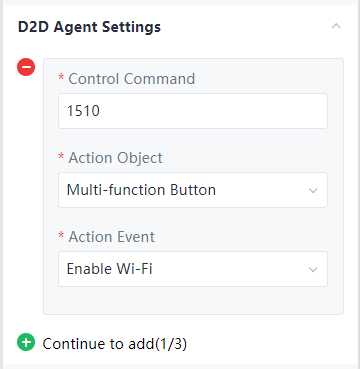
- After receiving D2D command 0x1510 from Milesight D2D controller devices,
the VS373 will trigger the multi-function button to enable Wi-Fi.
WLAN
- Scan
- The device scans for nearby 2.4GHz Wi-Fi networks and connects to to the
selected network.
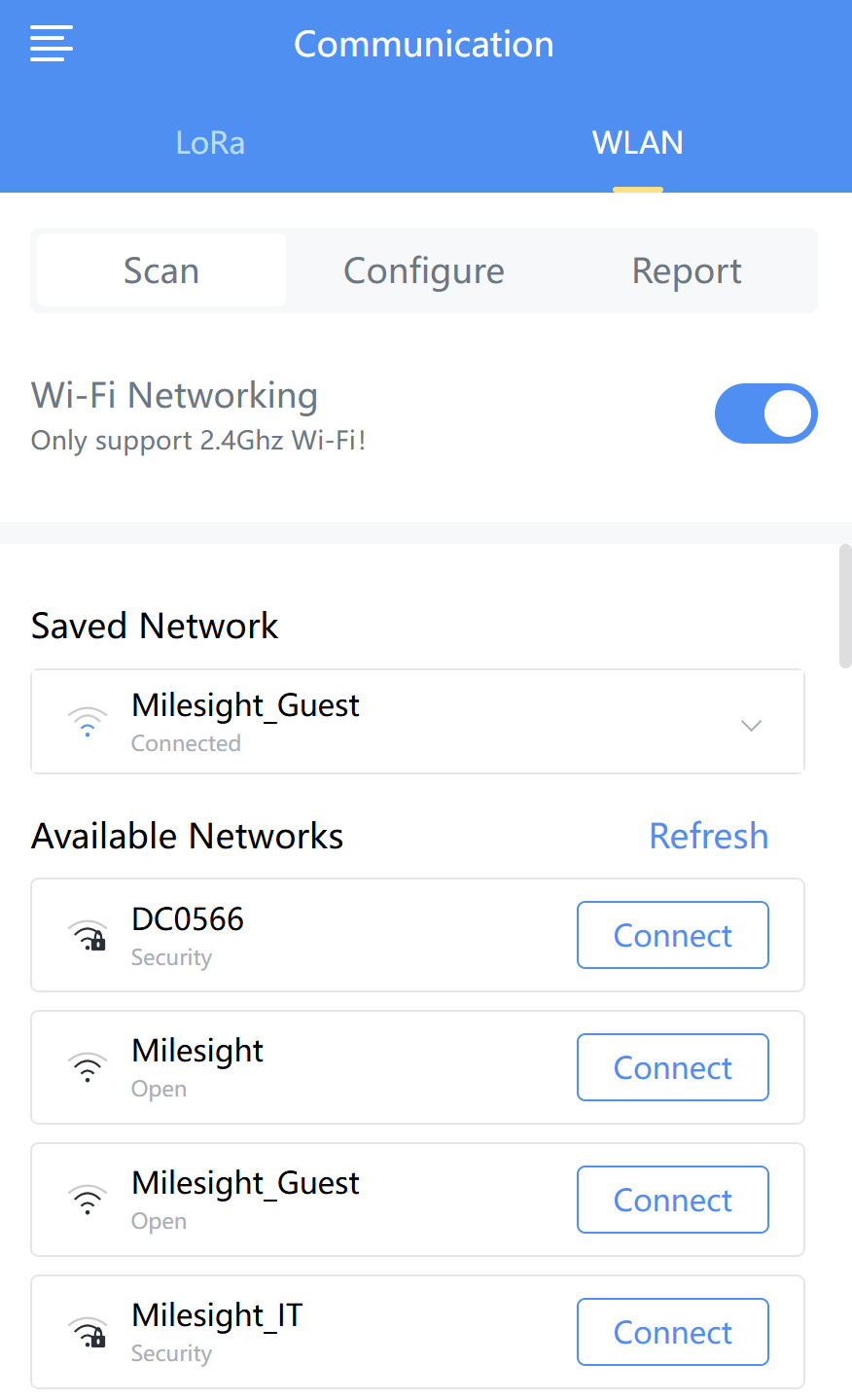
To connect, enable the Wi-Fi networking to scan for available networks. Select your preferred network, click Connect, and enter the password to join.
- Configure
- Modify the device's own WLAN settings.
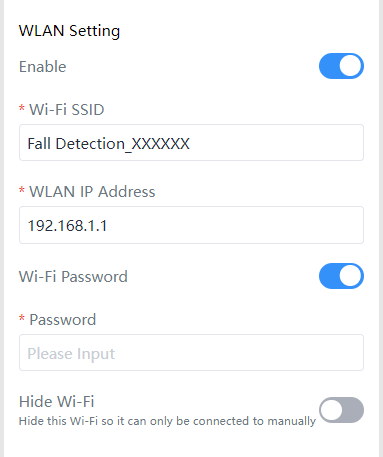
Parameters Description Enable Enable or disable Wi-Fi feature. This can also be turned on/off via multi-function button. Wi-Fi SSID The unique name for this device Wi-Fi access point, defined as Fall Detection_xxxxxx (can be found on the device label). WLAN IP Address Configure WLAN IP address for web access, the default IP address is 192.168.1.1. Wi-Fi Password Customize the password when security mode is not No Encryption. Hide Wi-Fi Hide this Wi-Fi to prevent discovery. The SSID must then be entered manually to connect.
- Report
- This section covers various settings related to Wi-Fi data transmission and
reporting. Please ensure that you are connected a Wi-Fi network .
Parameters Description Recipient Settings Report Protocol MQTT or HTTP is optional. Connect Status Connected or Disconnected. URL/Host The host of HTTP server or MQTT broker. Client ID Client ID is the unique identity of the client to the server. It must be unique when all clients are connected to the same server, and it is the key to handle messages at QoS 1 and 2. User Name The username used for connecting to the HTTP server or MQTT broker. Password The password used for connecting to the HTTP server or MQTT broker. Topic Topic name used for publishing. QoS QoS0, QoS1, and QoS2 are optional TLS Enable the TLS encryption in MQTT communication. Certificate Type CA Signed Server or Self Signed is optional.
CA Signed Server: verifying with the certificate issued by Certificate Authority (CA) that is pre-loaded on the device. Supported file formats for import include [.crt] and [.pem].
Self Signed: upload the custom CA certificates, client certificates and secret key for verification. Supported file formats for import include [.crt] and [.pem].
Report Settings Status Report Period The interval of period reporting. Periodic data information please see Periodic Report.
Data Retransmission Enable to resend stored data packets from the disconnected period when the device's network connection is restored. The device supports to store 1,000 pieces of data at most. Note:- When this feature is disabled, the existing retransmission data will be cleared.
- Switching protocols or modifying URL and topic does not require clearing retransmitted data.
- The historical data format is different from regular reports.
Trigger Report Trigger the following events to immediately report and alarm: Fall Alarm, Lying Alarm, Out of Bed Alarm, Dwell Alarm, Motionless Alarm, Bradycardia, Tachypnea, Occupied, Vacant Trigger data information please see Trigger Report.