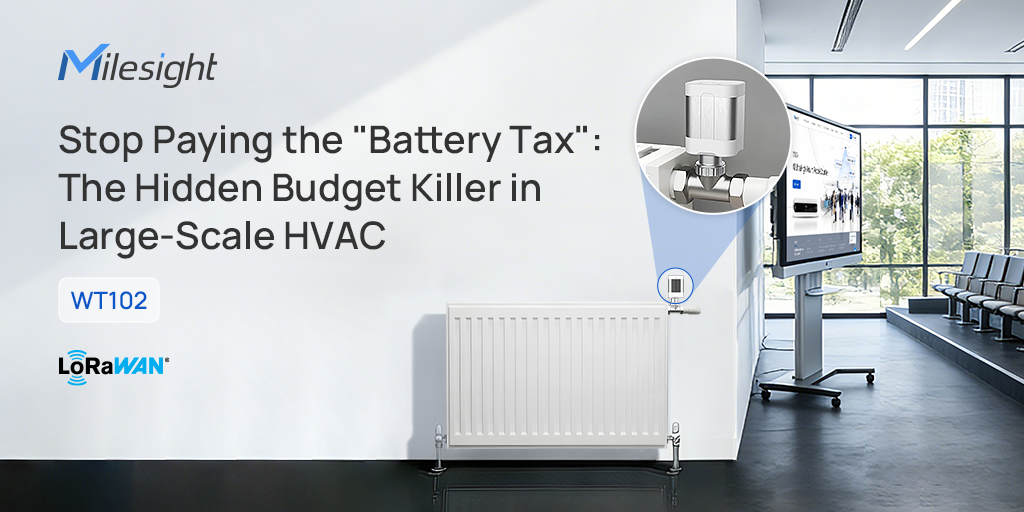
In an era of rising energy costs and urgent decarbonization goals, the demand for HVAC energy efficiency has never been higher. Efficient radiator control is no longer a choice but a necessity for commercial facilities looking to optimize consumption. However, the true cost reveals itself at scale. The recurring battery replacement cycle, often dismissed as a minor operational detail, becomes the dominant expense. It consumes the majority of total system ownership costs and systematically erodes the ROI that justified the initial investment.
It doesn't have to be this way. Imagine a thermostat that powers itself using the heat it already regulates. No batteries, no midnight alerts, no manual replacements. This isn't a hypothetical vision; it's the Milesight Smart Radiator Thermostat WT102, driven by groundbreaking Thermoelectric Energy Harvesting.
Why Do Traditional Batteries Struggle in Large-Scale Projects?
In small-scale applications, battery power is often seen as a mature and low-barrier solution. However, when a system spans multiple floors or entire campuses, its core limitations become a persistent operational burden:
Compounding Maintenance Costs
The primary expense in any large-scale deployment is the recurring need for physical intervention.
- Labor Intensity: Manually servicing thousands of radiators is extremely time-consuming and carries significant labor costs.
- Access Barriers: In sensitive environments like schools, hospitals, and hotels, maintenance teams often face "access friction." Coordinating room entry, securing permits, and waiting for guest availability often take far longer than the actual maintenance task.
- Operational Loss: The downtime required for batch servicing can disrupt daily operations, especially in high-occupancy commercial buildings where room availability is tied directly to revenue.
Unpredictable Lifespan Variability
Device longevity is rarely uniform. Differences in room temperature, installation location, and reporting frequency mean that devices from the same batch often require servicing at different times. This unpredictability prevents facility managers from creating efficient, unified maintenance schedules, leading to a constant cycle of reactive "firefighting" visits.
Environmental and Regulatory Pressure
Particularly in the European market, regulatory requirements for the disposal and recycling of chemical components are becoming more stringent. Managing the lifecycle of thousands of disposable components is no longer just a logistical task; it is a mandatory compliance burden under the EU Battery Regulation that carries its own significant set of costs.
Thermoelectric Energy Harvesting: The Natural Match for Radiator
What is Thermoelectric Energy Harvesting?
Based on the Seebeck Effect discovered in 1821, this technology directly converts temperature differences into electricity. When a thermal gradient exists across a thermoelectric module, charge carriers diffuse from the hot side to the cold side, creating an electrical potential. Unlike traditional power generation, it requires no mechanical turbines, operates in complete silence, and has no moving parts to wear out. It is a solid-state physics solution that turns a natural environmental condition into a sustainable stream of power. This is the same principle trusted by organizations like NASA to power deep-space probes for decades.
Why is it the Natural Match for Radiators?
Unlike other applications, radiator systems provide uniquely stable temperature differentials between hot pipes and ambient air. The Smart Radiator Thermostat WT102 captures this natural energy, converting otherwise wasted thermal heat into electrical power. By reusing existing energy rather than adding new sources, this technology is perfectly matched with modern low-power sensors. A fingernail-sized module can generate sufficient voltage with just a 15°C temperature difference, making it the most resilient choice for a smart HVAC solution.
What This Means in Practice:
- Continuous Power: As long as the radiator is heating, the device is harvesting energy, ensuring it stays operational when you need it most.
- Systemic Resilience: By using solid-state physics instead of chemical reactions, the power source is less susceptible to ambient temperature fluctuations or degradation over time.
- Simplified Infrastructure: The device operates as a self-sustaining node, reducing the complexity of long-term fleet management.
How WT102 Achieves a 70% Reduction in Total Costs
Milesight Smart Radiator Thermostat WT102 is engineered to transform heat into a measurable financial advantage. By eliminating the need for recurring manual intervention, this solution can lead to an estimated 70% saving in overall costs across the product lifecycle.
*Note: These figures are estimated based on general market cases and feedback from specific projects. Actual savings may vary depending on project implementation, local labor rates, and specific site conditions.
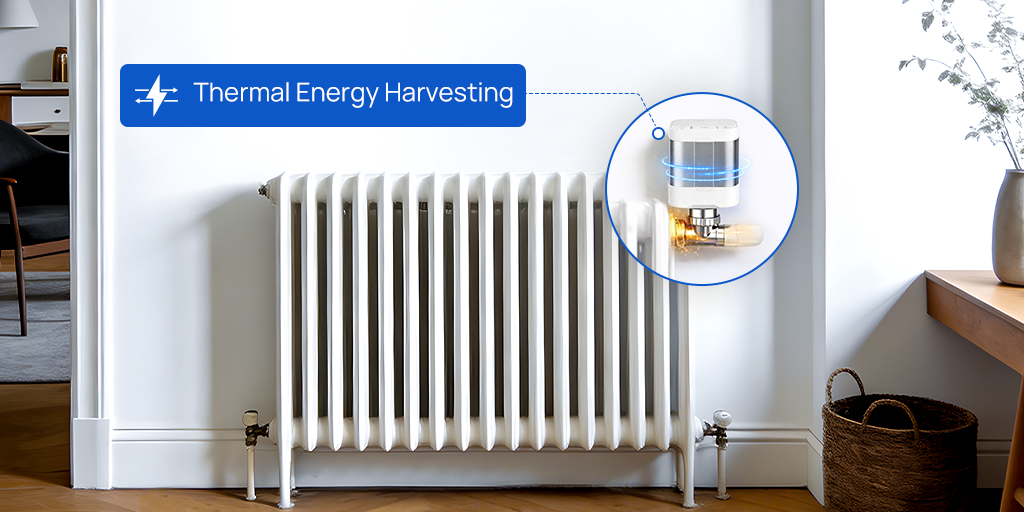
This comprehensive cost reduction is achieved through:
- Minimized Deployment Time: The integrated, one-piece design allows for rapid installation without the need for complex hardware assembly.
- Reduced Maintenance Labor: By removing the requirement for periodic power-related visits, technical teams can be redirected to higher-value building optimizations.
- Lower Logistical Friction: The elimination of room-access coordination and replacement logistics significantly lightens the operational load for facility management teams.
Conclusion
Transitioning to self-powered radiator control is a strategic move from recurring maintenance to long-term operational freedom. By eliminating the "hidden 70%" of maintenance costs, Milesight empowers the creation of more sustainable, efficient, and future-proof building environments.
👉Ready to melt the maintenance iceberg? Explore WT102 Now.
You May Also Want to Know:
Self-powered sounds great — but is thermoelectric energy harvesting reliable enough for real deployments? We answer every concern in our next deep dive.