Retail Dwell Time Explained:
Capture Shopper Attention and
Increase Conversions
In the modern retail landscape, getting customers through the door is only half the battle. The true driver of profitability lies in how effectively a store captures attention and retains it. Authoritative research by McKinsey & Company reveals a direct link between engagement and revenue: retailers that prioritize "experience-led" strategies, characterized by deeper shopper interactions and longer stays, can achieve a 2% to 7% increase in sales revenue and a 7% to 10% increase in total shareholder returns.
Retail dwell time, the measurement of how long visitors spend in a store or specific zones, provides a critical lens into engagement quality and shopping behavior patterns. By analyzing it alongside footfall and conversion rates, store managers can move beyond simple traffic counts to structured evaluation of the customer journey.
This article explores how advanced people counting technologies capture granular dwell time data and translate it into valuable insights, supporting actionable strategies that improve store performance and revenue efficiency.
What is Retail Dwell Time?
Retail dwell time is defined as the length of time a customer spends within a store in a specific area of a store or within the store as a whole. To drive genuine retail performance, it is typically analyzed alongside other key metrics:
Footfall Counting vs. Dwell Time
Footfall counting data tells you the volume of visitors by providing visitor distribution statistics across different time periods and store zones. Dwell time adds context by revealing whether shoppers quickly exit or stay to browse.
Retail Conversion Rate & Dwell Time
High dwell time with low conversion might indicate a pricing or stock issue, whereas low dwell time often points to poor store layout or a lack of shopper engagement. By correlating dwell time data with sales conversion figures, retailers can identify operational bottlenecks such as confusing product placement, ineffective promotional displays, or insufficient in-store guidance. This integrated analysis supports more precise adjustments to merchandising and marketing strategies.
Customer Engagement & Dwell Time
Dwell time acts as a proxy for customer interest. If shoppers linger in a promotional zone, it validates the effectiveness of your visual merchandising. Furthermore, dwell time is the ultimate metric for measuring the ROI of in-store marketing campaigns. By establishing a baseline and comparing dwell time data before, during, and after a campaign, retailers can accurately gauge whether a specific promotion or pop-up event successfully captured shopper attention.
Why Should Retailers Pay Attention to Dwell Time?
Monitoring dwell time offers a window into the customer's mindset. It is a direct reflection of the customer experience and the operational efficiency of your store's environment.
1. Enhancing Customer Experience & Queue Management
A longer dwell time is generally positive, but not always. It is crucial to distinguish between "good" dwell time (browsing, trying on clothes) and "bad" dwell time (waiting in long queues, searching for staff).
-
Scenario: A customer spending 15 minutes in the home decor section interacting with products is highly engaged.
-
Scenario: A customer spending 15 minutes in a checkout line is frustrated.
Abnormally high dwell time near checkout counters usually exposes checkout inefficiencies or understaffing. Identifying these differences helps retailers streamline service while encouraging browsing, which directly boosts customer satisfaction.
2. Optimizing Store Layouts
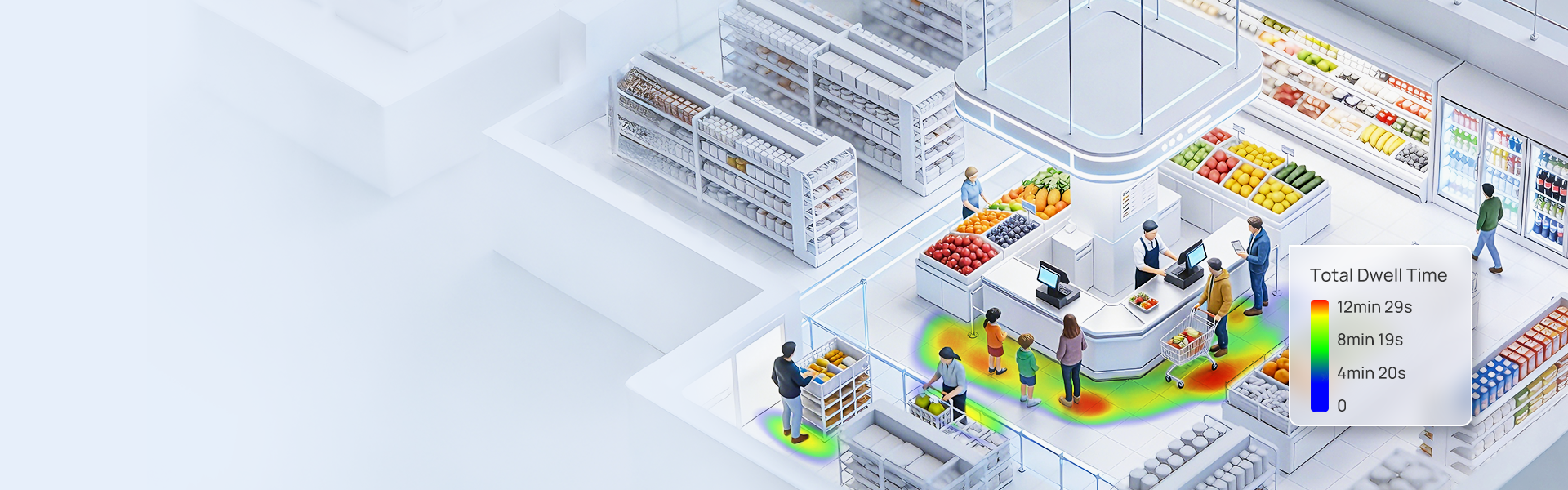
Heatmaps derived from dwell time data can reveal "hot" and "cold" zones. If a high-margin product aisle has low dwell time, it may be poorly lit, cluttered, or difficult to navigate.
A retail heat map is a visual representation of customer movement and engagement levels, typically using color gradients to highlight areas where shoppers spend more or less time. This visualization helps retailers clearly observe how customers interact with different store sections.
3. Gaining Insights into Customer Behavior
Dwell time helps retailers identify friction points that negatively impact sales. For example, prolonged waiting times for staff assistance can discourage customers and increase the likelihood of purchase abandonment. Similarly, unclear store navigation or insufficient directional signage may cause shoppers to wander without purpose, leading to frustration and reducing their willingness to continue browsing or completing purchases.
By identifying these behavioral patterns, retailers can proactively optimize service responsiveness and store navigation to support smoother customer journeys.
How to Measure Retail Dwell Time?
To effectively manage retail dwell time, accurate measurement is essential. Retailers can adopt various measurement approaches, ranging from traditional observation techniques to advanced AI-driven retail analytics technologies.
Traditional Methods
Manual Observation
Staff manually monitor and record how long customers remain in certain store areas. While this method provides basic dwell time insights, it is highly dependent on human judgment, prone to inaccuracies, and difficult to scale across multiple locations or high-traffic environments.
WiFi/Bluetooth Tracking
This method estimates customer dwell time by detecting signals from shoppers' smartphones. Although it can provide general traffic flow and visit duration data, it relies on customers enabling wireless connectivity and may raise privacy concerns related to MAC address tracking, which limits long-term reliability.
POS Data
Point-of-sale systems attempt to estimate dwell time by measuring the interval between store entry (if captured) and purchase completion. However, this method only reflects purchasing customers and excludes visitors who browse without buying, which can result in incomplete shopper behavior analytics and distorted performance insights.
AI Vision and Heat Map Technology
Modern retail dwell time analytics increasingly rely on AI-powered people counting sensors integrated with computer vision and behavioral analytics capabilities.
Industry-leading people counting devices, such as those developed by Milesight, combine high-accuracy people counting technologies with privacy-focused edge AI processing to deliver reliable and compliant retail analytics insights.
Object Tracking
AI sensors anonymously track the movement path of a customer object from store entry to exit, enabling precise measurement of total visit duration and in-store movement patterns while maintaining customer privacy.
Milesight VS125 Series powered by technologies such as stereo vision and AI-powered object recognition, widely adopted in modern people counting solutions, allow retailers to maintain high dwell time accuracy even in crowded or complex retail environments.
Heat Maps
Retail heat maps provide visual representations of customer engagement by highlighting areas where shoppers pause, interact, or move quickly. These visual analytics help retailers understand traffic concentration and engagement intensity across different store sections.
Milesight's retail people counting solutions, offer real-time and historical heat map visualization, enabling store operators to easily monitor shopper behavior trends and evaluate merchandising performance.
Zone Monitoring
Advanced analytics enable retail dwell time monitoring within specific store zones, allowing retailers to track customer stay duration in targeted areas such as product displays, promotional sections, or feature aisles. This helps retailers evaluate engagement levels and optimize performance within designated in-store locations.
Milesight VS125 Series AI Stereo Vision People Counters support dynamic zone setup and staff recognition, helping retailers capture more accurate engagement data while ensuring performance analysis reflects genuine customer behavior rather than employee activity.
How Retailers Can Boost Sales Performance by Increasing Dwell Time
Once measured, the goal is to implement strategies that naturally extend the customer journey without causing frustration. To encourage customers to stay longer, retailers must focus on value and comfort.
Strategic Store Visual Merchandising
Create "speed bumps" using eye-catching displays that cause customers to pause in high-traffic areas. Placing high-demand items at the back of the store encourages shoppers to traverse more aisles, increasing exposure to other products along the way.
Data-Driven Staff Scheduling
If dwell time analytics show that customers leave quickly during lunch hours, it might be due to a lack of staff assistance. Aligning staff schedules with peak dwell times ensures customers get help exactly when they are most interested in buying.
Design That Enhances the Overall Shopping Experience
Incorporating non-transactional elements can significantly boost dwell time:
-
Rest Areas: Comfortable seating for companions allows the primary shopper to browse longer without pressure to leave.
-
In-Store Services: Coffee stations, tasting bars, or interactive tech demos turn a simple shopping trip into a leisure activity. Embracing a "try-before-you-buy" concept allows customers to physically interact with products.
Interactive Marketing Activities
Digital signage and pop-up events can capture attention. For example, a gamified QR code promotion in a low-traffic corner can drive footfall and increase dwell time in that specific zone.
Improving Store Ambiance
Optimizing the retail atmosphere through sensory marketing, such as playing tempo-appropriate background music, utilizing warm lighting in fitting rooms, or introducing pleasant brand-aligned scents, can significantly relax shoppers, effectively extending their average shopping time.
How to Choose a People Counter for Measuring Dwell Time
Selecting the right people counting technology is critical for obtaining accurate and actionable retail dwell time analytics. When evaluating people counting solutions designed for dwell time measurement and shopper behavior analysis, retailers should focus on the following four key areas.
Accuracy
High accuracy is fundamental for reliable people counting and retail dwell time tracking. Look for footfall counters that deliver at least 98–99% counting accuracy. Low-accuracy technologies, such as basic infrared beam counters, struggle to distinguish between individuals, groups, or bidirectional movement.
Privacy Protection (GDPR Compliance)
Privacy protection is essential when deploying people counting systems that monitor customer movement. Advanced AI people counting sensors should utilize edge computing to process image data directly on the device and output only anonymous statistical data.
Device AI Features
To support comprehensive retail dwell time analysis, people counting devices should offer advanced behavioral analytics capabilities such as multi-zone detection, heat mapping, and customer segmentation. The ability to differentiate between staff and visitors (staff exclusion) is particularly important, as employee movement can otherwise inflate traffic metrics and distort dwell time performance analysis. These features enable more precise monitoring of customer engagement across different store areas.
Deployment Flexibility
Flexible deployment options are essential for scalable people counting and dwell time monitoring across diverse retail environments. Technologies such as PoE (Power over Ethernet) and LoRaWAN® connectivity allow for simplified installation and long-distance data transmission with minimal infrastructure changes. Additionally, the people counting system should seamlessly integrate with existing retail analytics dashboards, business intelligence platforms, or POS systems to support centralized data management and performance tracking.
Enhancing Retail Insights with AI Retail People Counting Solutions
For retailers seeking a robust, future-proof solution, Milesight Retail Traffic Counters deliver precision, privacy, and actionable insights all in one. Designed with GDPR compliance by default, these sensors use AI Time-of-Flight (ToF) or stereoscopic vision to detect anonymous 3D shapes rather than capturing video, ensuring 100% shopper privacy.
Retail Dwell Time & Heat Maps
Generate real-time heat maps to instantly visualize store hot spots and dead zones, no complex software integration required. This gives managers an immediate view of customer movement patterns.
Staff Recognition
Staff movements are automatically filtered out using identifiable tags or reflective strips, ensuring dwell time metrics reflect actual shopper behavior.
Group Counting
AI-powered group counting distinguishes between individuals and groups (e.g., families), providing more accurate calculations of sales conversion rates.
Attribution Recognition
Anonymously analyze demographic attributes, such as gender, adult vs. child, to better tailor inventory and promotions.
Shopping Cart Fill Level Detection
Monitor cart fill levels to understand customer purchase intent and optimize product placement and promotions.
Multi-device Stitching
Combine data from multiple sensors seamlessly to track customer flow across larger areas, ensuring a complete and accurate view of store traffic.
By leveraging the Milesight retail people counting solution, retailers can monitor occupancy and customer flow from a single dashboard, enabling proactive decision-making and optimizing the shopping experience for maximum engagement and profitability.
Frequently Asked Questions
In what retail scenarios is measuring dwell time most critical?

Retail dwell time is especially valuable in high-engagement zones such as promotional displays, feature aisles, interactive demo areas, and checkout or service points. For example:
Apparel stores: Track time spent in fitting rooms or around new collection displays to evaluate visual merchandising effectiveness.
Grocery or supermarket aisles: Monitor engagement with seasonal promotions, product bundles, or specialty sections to optimize layout and stocking.
Electronics or tech stores: Measure customer interaction with demo stations or product displays to fine-tune in-store guidance and staff assistance.
Shopping Malls: Assessing which atrium displays or lounge areas hold visitor attention longest.
Automotive Showrooms: Measuring how long potential buyers interact with specific car models to gauge purchase intent.
Museums and Galleries: Tracking time spent in front of specific exhibits to understand visitor interests and optimize future exhibition layouts.
By analyzing dwell time in these scenarios, retailers can optimize store layouts, tailor staff allocation, and enhance customer engagement to drive sales.
Can I measure dwell time for specific products?
Yes. Advanced sensors let you create virtual zones around specific displays or shelves, enabling precise measurement of how long shoppers interact with each product. This data helps retailers understand customer engagement at the product level, optimize product placement, and tailor marketing or promotions for maximum impact.
Can I track customer engagement across multiple store zones simultaneously?
Absolutely. With multi-zone monitoring and multi-device stitching, Milesight sensors can capture shopper movements across different areas or multiple connected sensors. This enables a complete view of customer flow, helping retailers optimize store layouts, promotional displays, and engagement strategies.
If you are interested in Milesight, please leave us a message.
Contact Us
Contact Us
Contact Us to Get More Information