Why Building Integration Is Still Hard?
And What It Actually Takes to Get It Right

Table of Content
Smart buildings are often described in terms of outcomes: centralized control, real-time visibility, and improved energy efficiency. Yet behind these benefits lies a far more fundamental challenge: getting multiple building systems to actually work together.
In real-world deployments, integration is where many projects ultimately succeed or fail.
The Reality: Buildings Are Not Designed as Unified Systems
On paper, modern buildings appear highly structured. In practice, they are anything but. A typical building is the result of years or decades of incremental upgrades. HVAC systems may run on BACnet, energy meters on Modbus, lighting on KNX, and legacy infrastructure on M-Bus or direct I/O. More recently, wireless sensors have been added through LoRaWAN.
Each system functions reliably within its own domain. The difficulty begins when they are expected to operate as a single, coordinated system. There is no shared data model, no unified communication layer, and no inherent interoperability. Integration is not built-in. It has to be engineered, often from scratch. This is where the real challenge begins.
The Industry’s Default Response: Add More Layers
To manage this complexity, the industry has often taken a straightforward approach: add more gateways and converters. A wired gateway connects legacy infrastructure. A LoRaWAN gateway handles wireless sensors. Protocol converters bridge gaps between systems. Each component addresses a specific issue, and in isolation, each decision is reasonable.
However, over time, this leads to a layered architecture where:
- configuration becomes distributed across multiple devices
- dependencies increase between system components
- troubleshooting requires cross-layer visibility
- scaling the system introduces exponential complexity
What starts as flexibility gradually turns into operational burden.
A Different Perspective: Integration as Complexity Reduction
Projects that succeed at scale tend to approach integration differently. Instead of asking how to connect more systems, they focus on how to reduce the structural complexity of integration itself.
In practice, this means designing systems with several key principles in mind:
- Protocol convergence: supporting multiple building protocols natively, rather than relying on external converters
- Architecture unification: avoiding parallel wired and wireless infrastructures
- Edge intelligence: processing data locally to reduce latency and system dependency
- Deployment simplicity: minimizing on-site engineering effort
- Environmental adaptability: accounting for real-world constraints from the outset
These are not feature checklists. They reflect an engineering mindset—one that treats integration as a problem of system design, not just connectivity.
From Connectivity to Integration Depth
This shift leads to a fundamentally different way of building systems. Rather than distributing functions across multiple devices, integration is consolidated at the edge. A single platform can handle protocol translation, data processing, and system coordination, reducing the number of layers required to achieve interoperability. This is what “deep integration” looks like in practice: not adding more components, but absorbing complexity into a more coherent architecture.
Milesight’s EG71 Building IoT Gateway is an example of this approach. The goal is not simply to connect devices, but to reduce the number of integration layers required to make those devices work together.
EG71Building IoT Gateway: From Wired and Wireless Connectivity to Simplified Integration
EG71 introduces a unified integration approach, bringing wired and wireless ecosystems together within a single, intelligent edge device. With support for multiple mainstream protocols, including Modbus, BACnet, KNX, M-Bus, I/O, and LoRaWAN, EG71 enables:
- Seamless data aggregation across heterogeneous systems
- Protocol conversion without additional hardware
- Local data processing and control at the edge
Beyond southbound connectivity, EG71 provides flexible northbound communication to ensure data can be efficiently delivered to building management systems and cloud platforms.
With support for protocols such as MQTT(s), HTTP(s), ModBus TCP and BACnet/IP, EG71 enables:
- Direct integration with local BMS systems
- Secure data transmission to cloud-based platforms
- Standardized data flow across different management systems
This bridges the gap between field devices and upper-level applications, transforming fragmented data into structured and actionable insights.
Integration Is the Real Foundation of Smart Buildings
As building technologies continue to evolve, the definition of “smart” is also changing. It is no longer about how many devices are connected or how much data is collected. What matters is whether systems can operate together within a coherent, scalable architecture.
For system integrators and solution providers, this requires a shift in starting point. Integration should not be treated as the final step of a project, but as the foundation of system design. Because ultimately, a building is not defined by the number of systems it contains—but by how well those systems work together.
Milesight Related Products
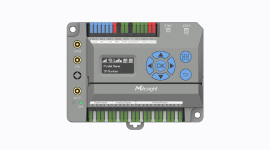
EG71 Building IoT Gateway
EG71 is an intelligent edge IoT gateway that unifies wired and wireless connectivity in a single device, simplifying data aggregation, protocol conversion, and local control for smart building integration across both new construction and retrofit projects.
Explore More