It's 2 a.m. A guest checked out six hours ago. The room sits empty until morning — but the fan coil unit is still running at full output, holding a setpoint nobody asked for. Hotel rooms are unoccupied for an average of 12 hours each day, according to ENERGY STAR research on lodging energy use, while HVAC systems account for 30 to 50 percent of a hotel's total energy consumption, according to a peer-reviewed analysis published in ScienceDirect. Occupancy-based control, switching to an energy setback the moment a guest leaves and restoring comfort on arrival, is the most direct way to close that gap without touching the guest experience.
The technology to do this wirelessly exists. What hospitality operators and system integrators need to know is whether it works reliably enough to trust at scale, floor after floor, room after room. That's the question this test was built to answer.
Why LoRaWAN® Had Something to Prove
A leading hospitality system integrator came to us with existing benchmarks from two other wireless technologies:
| Technology | Communication Success Rate |
| Zigbee | 99% |
| Wi-Fi | 100% |
| LoRaWAN® | ? |
LoRaWAN® offered real advantages for a hospitality deployment: no new cabling, better range across floors, lower infrastructure cost, and ultra-low power consumption with multi-year battery life on sensors. But in a dense, multi-floor hotel environment with hundreds of simultaneous devices, real-world reliability had never been formally documented. So we designed a test rigorous enough to answer it definitively—for this client and for every hospitality integrator evaluating LoRaWAN® at scale.
What We Built: 100 Guest Rooms, Simulated
This was not a proof-of-concept with a handful of nodes in a clean RF environment. We modeled a full three-floor, 100-room hotel on the US915 frequency band with 200 active devices running continuous occupancy-triggered interactions across a 135-hour test window.
Test Scale
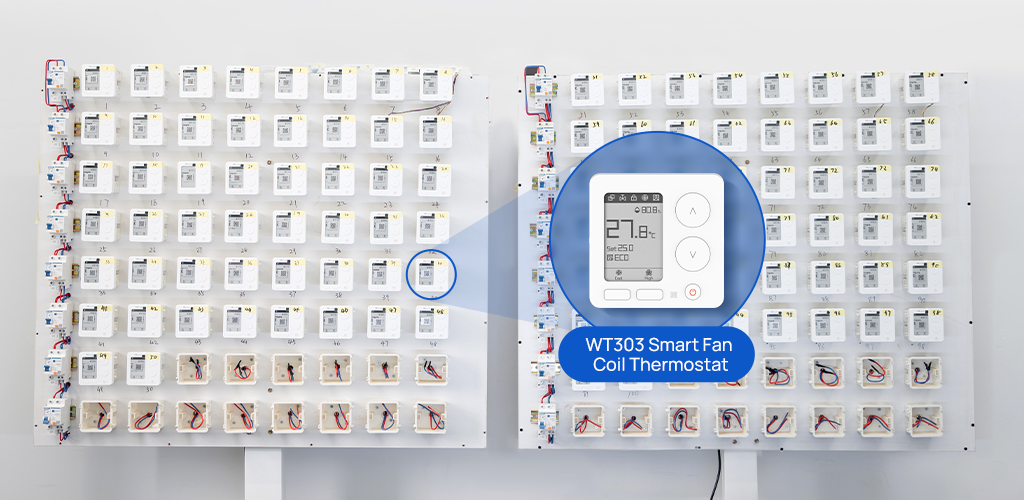
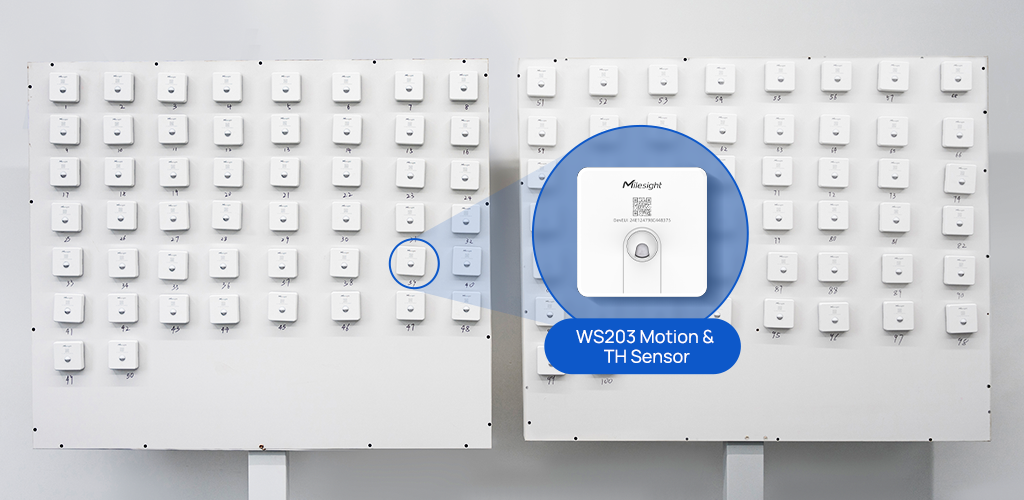
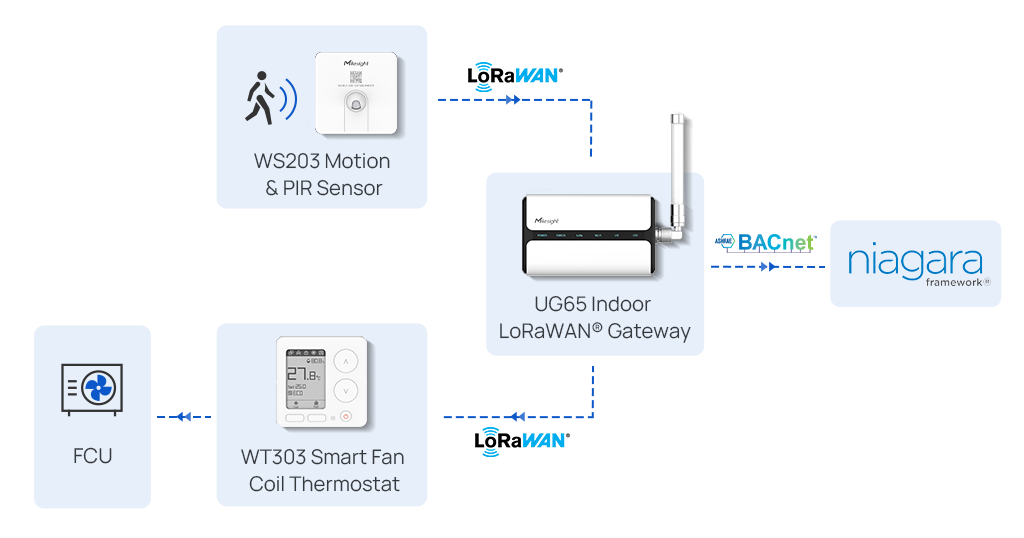
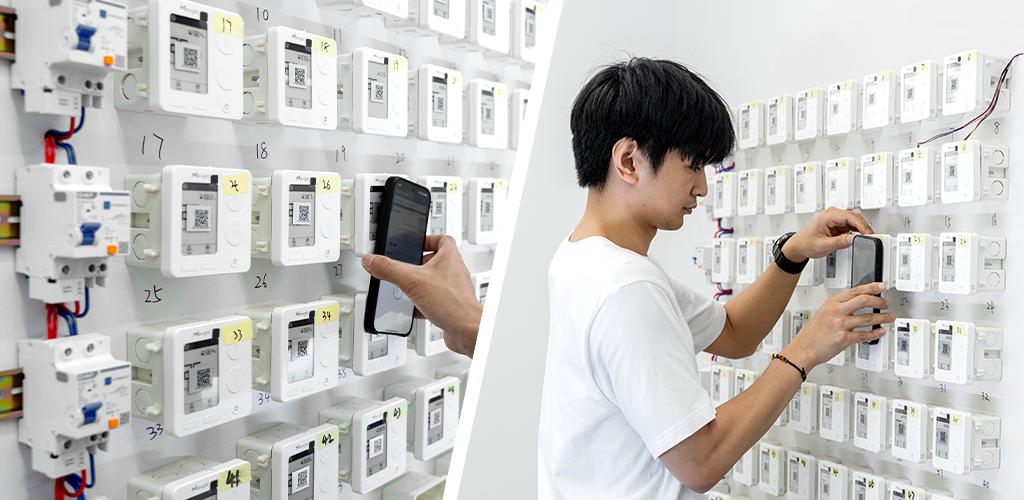
100 WT303 Smart Fan Coil Thermostats, 100 WS203 Motion & TH Sensors, 2 UG65 LoRaWAN® Gateways in primary/secondary configuration. 202,111 total communication cycles logged over 135 hours of uninterrupted operation.
The Communication Chain
Every cycle followed a complete occupancy control loop: the WS203 detects guest presence and reports room status, the UG65 processes the signal through Node-RED automation logic and dispatches a setpoint command to the WT303, and the WT303 executes the adjustment and returns an ACK confirmation. Every link had to close for a cycle to count as a success. A missed uplink, failed downlink, or unconfirmed execution all counted against the score.
Test Conditions
154 external devices were actively transmitting on the same frequencies throughout the test — a realistic representation of shared-spectrum RF conditions in a real hotel environment. They weren't filtered out. The numbers that came back are numbers from a real-world RF environment, not an isolated chamber.
The Results
The 99.26% headline figure reflects six rounds of parameter optimization before the final 135-hour validation run. Spreading factor selection, retry logic, gateway configuration, and reporting intervals were all tuned and re-tested. The methodology behind that process is documented in full in the test report. The outcome:
- 99.26%: Overall system link success rate across 202,111 data cycles
- 100%: Device online rate maintained throughout the full 135-hour run
- 72 out of 100: Device pairs achieving ≥99% individual success rate
- 100%: FUOTA remote firmware upgrade success across all 100 thermostats, completed within 2 hours
The 72 of 100 pairs reflects performance under stress-test conditions: in this test, the WS203 reported on a fixed periodic schedule to maximize data volume, generating significantly higher channel load than a real hotel deployment would ever produce. In practice, sensors only transmit when occupancy status actually changes — meaning far less channel congestion and more reliable message delivery. Under standard default configuration, the baseline any integrator would start from, all room pairs are capable of reaching ≥99% individual success rate.
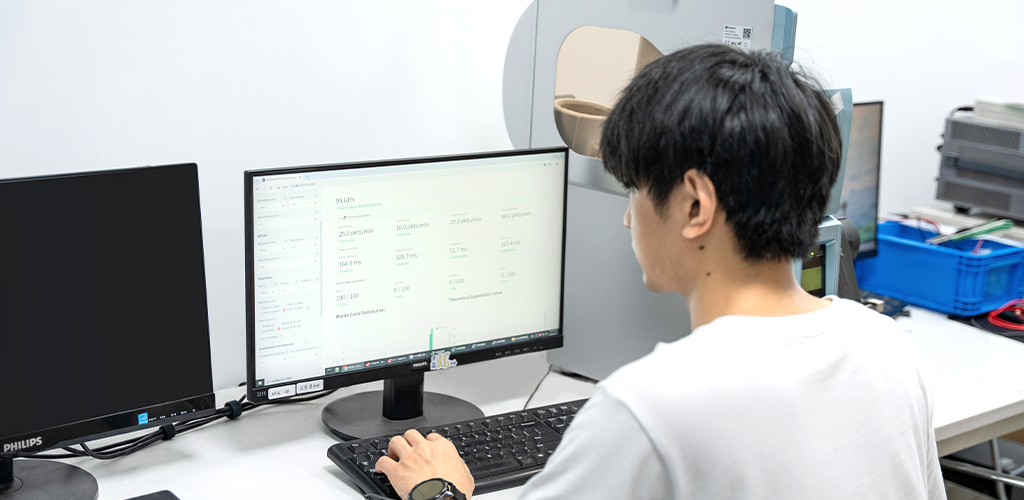
Those same test parameters also fed into a simulation model that allows integrators to predict link success rates for their specific deployment before going to site—adjusting device count, gateway configuration, reporting intervals, and other variables to validate a setup in advance.
What This Means for Your Deployment
A 99.26% success rate across 200,000 interactions translates directly into outcomes that matter for hotel operations:
1. Reliable guest comfort from check-in. Occupancy control engages the moment a guest enters, every time. No delays, no missed triggers, no rooms that fail to respond when it counts.
2. Consistent unoccupied setback. When a guest checks out or leaves the room, the setback command reaches the thermostat reliably. The energy savings that make occupancy automation worth deploying depend entirely on this link holding — and this test confirms it does.
3. Deployment confidence at scale. For system integrators taking this solution to hotel clients, the reliability question now has a documented, reproducible answer, validated under conditions that reflect actual deployment environments, and available to share before any project commitment.
Explore the Full Report
The complete test report covers the full methodology, per-device success data across all 100 room pairs, configuration details, AI simulation model output, and deployment guidance for scaling to larger hotel properties.
👉Download the Full Test Report
A Complete LoRaWAN® Hotel Automation Ecosystem
The WS203 and WT303 are part of a broader Milesight LoRaWAN® solution designed for hospitality environments. Smart thermostats work alongside occupancy sensors, door and window sensors, indoor air quality sensors, and light sensors to build a fully connected guest room—where every climate decision is informed by real-time room state. All data is simultaneously transmitted through Milesight LoRaWAN® gateways to cloud platforms or BMS infrastructure via standard protocols, including BACnet, forming a complete hotel building automation system. The result is a measurable improvement in both guest comfort and energy efficiency, without adding complexity to day-to-day hotel operations.
Planning a hotel deployment and want to model your specific scenario before going to the site? Our team can run the numbers.